

Sanet y Negrals
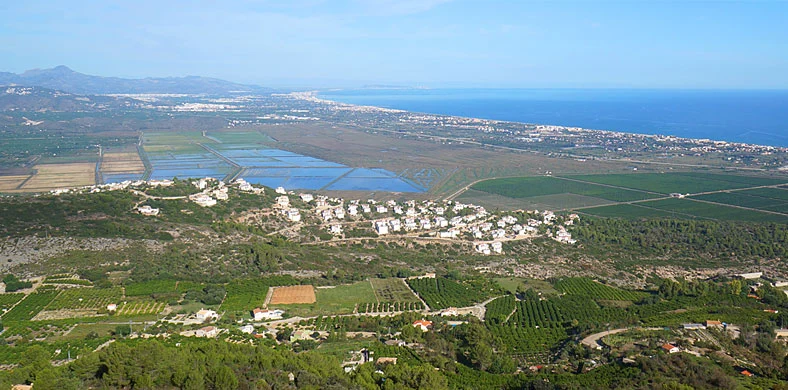
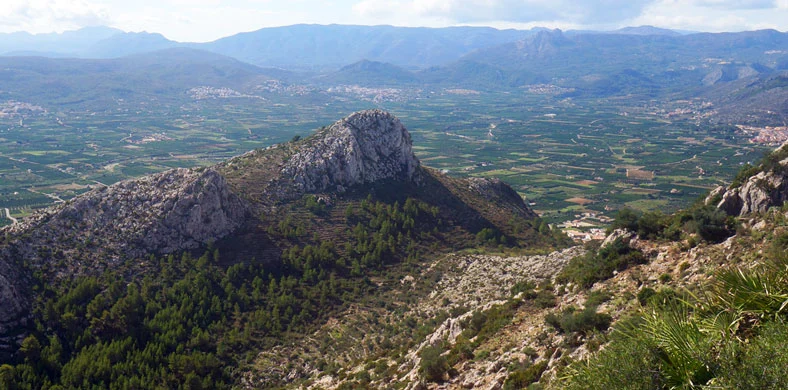

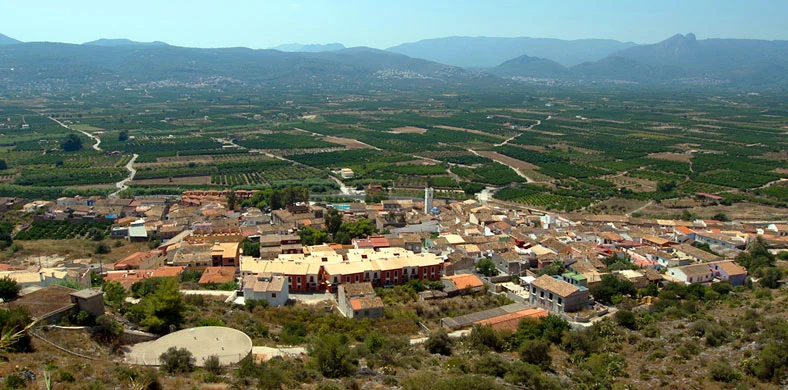
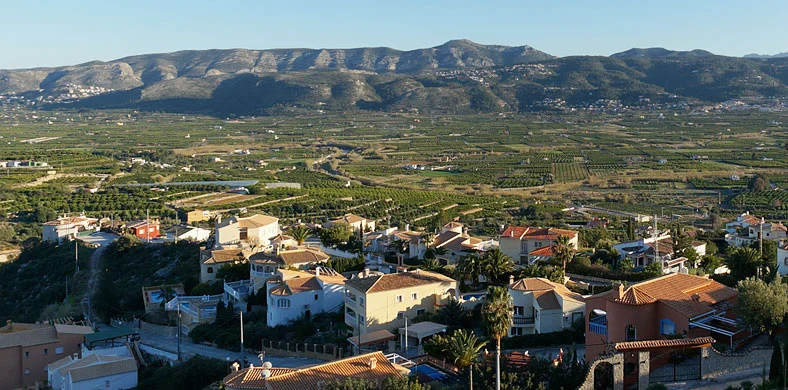
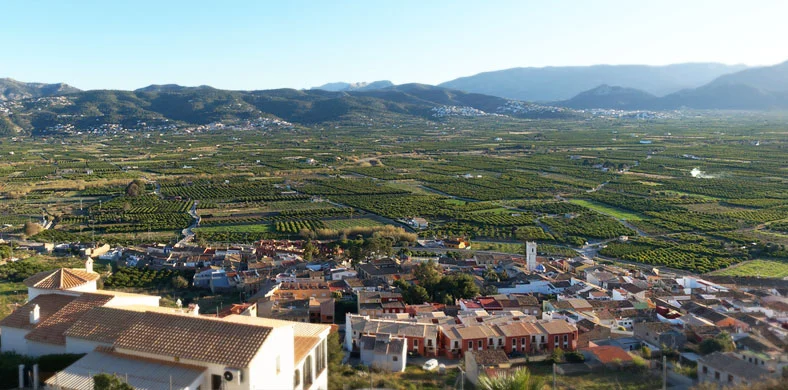

Sanet y Negrals is a municipality in the Valencian Community (Spain). It is located in the northeast of the province of Alicante, in the Marina Alta region and sub-region called La Rectoría. It currently has 727 inhabitants (Source: National Institute of Statistics – Municipal Register 2010)
Its belonging to the valley formed by the Girona River makes its lands fertile with irrigated agriculture of vegetables, fruit trees, and especially citrus fruits with an important export activity.
Adjacent to Sanet y Negrals we find the Sierra de Segaria, with a temperate climate and 10 km from the beach. It borders the municipal terms of Beniarbeig, Benidoleig, Benimeli and Tormos.
As a curiosity, it should be noted that the first written record of the use of the term "Catalan language" refers to this municipality. It is the cession of the sites of Sagra and Sanet to the Order of Santiago, signed by the notary Bernat Soler on September 17, 1341 (National Historical Archive, Military Orders, Uclés, Sagra and Sanet, folder 307, no. 6).
In 1570 the Lloc de Negrals was acquired by D. Lorenzo Merita, during the reign of Philip II.
The expulsion of the Moriscos greatly affected the status of what were then independent towns. As a consequence of the disposition of the Cortes of 1626, the town of Negrals lost its condition as a town. This disposition established that the towns affected by the expulsion of the Moriscos that did not manage to attract sufficient repopulators would lose their condition as such. As a result of these events, the Pascual lords, nobles of Oliva to whom the town had belonged since ancient times, lost jurisdictional powers in favor of the Marquis of Denia. Unlike what happened with the town of Negrals, the towns of Sagra and Sanet did manage to attract sufficient repopulators and were able to maintain their status. The old Christians who repopulated these lands came from nearby towns, such as Penáguila, Oliva and Pego, and from more distant areas such as Catalonia and Mallorca.
In 1834 the two nuclei joined to form the current Sanet y Negrals.
In the Sierra de Segaría, in addition to the Iberian settlement, the remains of the Bolumini Cave, the remains of Arab terraces and the remains of what was the sumptuous house of the Arab prince Abd-El-Melichi Almuzafar, known as "The Seat of the Moorish King" (La Cadireta del Rei Moro) are important.
In this mountain range we also have the Segaria Viewpoint from where we can appreciate magnificent views such as the Marjal de Pego-Oliva Natural Park, the Castle of Denia, the Montgó Natural Park, the mountains surrounding the Girona River valley, the mountains of the Ebo and Gallinera valleys, the Sierra de Mariola Natural Park, and if there is a clear day we can observe the island of Ibiza.
We can visit the Catalá Spring, with very hard and fresh water, and the Cave of the Lady.
Festivals
- Pigeon Racing Festivals. Festivals celebrated in June in honor of "Saint Anthony" and Youth.
- Christ Festivals. Patron festivals celebrated in the first week of September in honor of Christ of Health and Saint Anne.
Notable People
- Dr. Tomás Mut Mut, was born in Sanet i Negrals in 1919 and died in Gandía in 1992, being buried in our town. He graduated in Medicine and Surgery from the University of Valencia in 1944, and studied specializing in traumatology and orthopedic surgery in Madrid, Barcelona and Valencia, and leprology at the University of Madrid.
He developed his professional work, with great recognition, as head of the surgery service of the Fontilles leper sanatorium, and titular physician of the Emergency House of the Gandía City Council.
Mut was the author of numerous works on traumatology and leprology, published in prestigious medical journals, and in 1949 he opened his own clinic in Gandía that became a reference for the inhabitants not only of the city but of the Central Valencian Regions. - Jorge Morell Estela, 1st world 125cc motorcycle mechanic Blusens Paris Hilton.
- Kiko Femenía, professional footballer signed by Real Madrid.
Monuments and Places of Interest
- Parish Church. Romanesque style.
- The Manor. Palace of the Lords of Merita, located in the urban center.
- The Magnolia. Centennial tree imported from America. Of high botanical interest, it is a species that existed before the appearance of bees and therefore its flowers developed so that they could be pollinated by beetles. As a consequence, they have hard carpels to prevent their deterioration. Fossilized specimens of M. acuminata have been found that are 20 million years old and plants belonging to the Magnoliaceae family that date back 95 million years have been identified. As a curiosity, it is the largest tree in the province of Alicante.
- Christ Square. Square built with economic participation from the entire town, offers an unbeatable panoramic view of the valley. On one side of the square we have the sports center and municipal pool and on the other side the municipal park.
- The Hermitage, was built with the participation and donations of the entire town.
- Our springs, we have 3 natural water springs, the Rafol water ditch, the Plans and Canets spring and the Huertas spring.
- Mill, there is a mill where in ancient times wheat was ground to make flour and this worked with water.
- Les peñetes rotjes, that in ancient times the farmers had a refinery and knew the hours.


©2026 Montesano Villas y Servicios · All Rights Reserved · Legal information, Privacy policy and cookies.
